
Our Services
Specialized DUI toxicology reviews for Oklahoma cannabis cases
Toxicology Review
Detailed analysis of mass spec chromatography reports for defense cases
Expert Testimony
Providing clear, evidence-based explanations in court for cannabis DUI cases


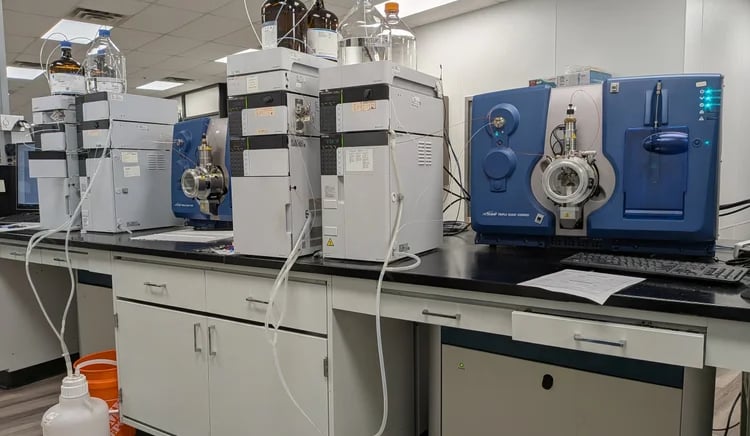
Sciex 4500s, personal photo
Your Professional Review HERE
J. Smith


★★★★★
FAQs
What is chromatography?
Chromatography is a laboratory technique that separates complex chemical mixtures so individual compounds—like THC, metabolites, or other drugs—can be accurately identified and quantified.
How do you help attorneys?
I conduct independent reviews of Oklahoma DUI toxicology reports, examining chromatograms, MRM transitions, instrument calibration, quality controls, and method performance to identify analytical errors, false positives, or results that do not indicate impairment.
Why specialize in cannabis DUI cases?
Cannabis DUI cases require careful interpretation because THC metabolites can remain in the body long after impairment has passed. My background in cannabis mass spectrometry and OMMA-regulated laboratory operations allows me to evaluate whether a test truly reflects recent use—or simply past exposure.
Mass spectrometry identifies chemicals based on their mass-to-charge ratio and fragmentation pattern. In DUI testing, it is used to confirm the presence of Δ9-THC and its metabolites through multiple MRM transitions. Missing or weak transitions can lead to false positives or incorrect conclusions.
Can you explain mass spec chromatography?
How do I start working with you?
You can contact me directly to discuss your case. I’ll review the toxicology documents, explain potential issues, and provide next steps for a full analytical evaluation or expert testimony.
Contact
Expert analysis for Oklahoma DUI cases
© 2025. All rights reserved.
ChromatographyConsultingOK@gmail.com
ChromatographyConsultingOK@gmail.com